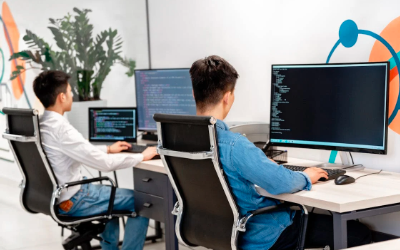
In many technology companies, growth no longer depends solely on what happens inside their internal teams. A significant portion of innovation now emerges outside the organization, within developer communities that use, modify, or expand the tools those companies create.
This dynamic is characteristic of the tech sector: products evolve thanks to thousands of professionals distributed across different countries, working in diverse cultural and technical contexts.
An Ecosystem That Grows Beyond the Company
For many years, technology companies focused primarily on internal development. Engineering teams designed new features, product departments defined the direction of platforms, and end users adopted those tools.
Today, the landscape looks quite different. Many companies recognize that the true potential of their technologies emerges when others begin experimenting with them. An independent developer might discover an unexpected use for an API. A startup may create a complementary service that extends the reach of a platform. Entire communities can even form around open-source libraries.
For this to happen, companies need to create environments where this exchange is possible. Accessible technical documentation, active forums, specialized events, and partner programs are some of the most common ways to encourage participation.
The Role of Events in Building Community
Technology communities often grow around spaces where developers can meet, share experiences, and discuss technical solutions. Events organized by companies themselves or by independent communities play an important role in this process.
Developer conferences, hackathons, technical workshops, and regional meetups act as connection points for professionals working on similar projects. In these spaces, presentations usually combine demonstrations of new features with discussions about real technical challenges.
Many developers especially value these opportunities because they allow them to hear directly from the people who design the platforms. An engineer may explain how a new microservices architecture works or detail the technical decisions behind a major update.
But knowledge sharing does not happen only on stage. Informal conversations in hallways or during networking sessions are often just as valuable.
Knowledge That Moves Across Continents
One of the most interesting characteristics of technology communities is their global nature. A developer in São Paulo might work with tools created in California, collaborate with a team in Berlin, and discuss solutions with colleagues in Singapore.
Digital platforms have greatly facilitated this type of interaction. Technical forums, open-source repositories, and specialized communication channels allow professionals from different countries to share solutions to complex problems.
However, when companies aim to strengthen these communities, they often organize events that bring participants from multiple regions together. Some of these events take place in person, while others gather thousands of people in virtual environments.
In both cases, the objective is usually the same: to create a space where technical knowledge can circulate quickly and where participants feel part of a broader network.
Linguistic Diversity in Technology Communities
As developer communities expand, linguistic diversity also becomes increasingly visible. Participants may come from different educational systems, professional cultures, and technical environments.
Although English often functions as a common language in many tech settings, not all participants feel equally comfortable using it to discuss complex topics. When presenting technical concepts or sophisticated architectures, clarity of language becomes especially important.
This is particularly evident at events where professionals from different regions of the world participate. During a technical session, a developer may want to ask a specific question about implementing an algorithm or about the performance of a distributed database. If the explanation loses precision during the linguistic exchange, the conversation can quickly become confusing.
For this reason, some international events that bring together large communities incorporate solutions such as interpretation for remote events, allowing participants who speak different languages to follow presentations and actively engage in technical discussions.
More Than Technology: A Network of Collective Learning
Developer communities do not function only as spaces for technical support. They are also places where collective learning takes shape.
A programmer may find solutions to problems that others have already encountered. At the same time, they can share their own experience and help improve tools used by thousands of people.
This constant flow of knowledge creates something unique. Technology stops being simply a product and becomes a platform where multiple actors contribute to its development.
Companies that understand this dynamic tend to adopt a different role. Instead of fully controlling the innovation process, they facilitate environments where others can experiment, create, and propose new ideas.
A Phenomenon That Continues to Evolve
Developer communities continue to grow as new technologies transform the industry. Artificial intelligence, cloud computing, cybersecurity, and automation constantly generate new spaces for collaboration.
More and more companies recognize that innovation does not emerge solely from their internal labs. It also arises from the interaction of thousands of professionals who explore, test, and adapt technological tools in different contexts.
Within this global network, communities function as living systems where ideas, practices, and solutions circulate. A developer anywhere in the world can contribute to improving a platform used by millions of people—and that collective exchange ultimately reshapes the reach of many technologies.
About the Author